The 5th Forum of Municipalities Committed to Equality consolidates local feminist leadership and asserts that collective empowerment is key to transformation.
Santa Coloma de Gramenet, 24 October 2025 – The fifth Forum of Municipalities Committed to Equality, held at La CIBA, brought together over 100 institutional representatives, professionals, and activists for a day that emphasised the importance of local feminist leadership in addressing contemporary democratic issues.
Organised by the Forgender Seal Association, with the support of the European Union, the forum focused on moving towards feminist municipal governance with sustainable, accessible equality policies that have a real impact. The slogan of this edition was: “Feminism and local politics: an alliance to transform society'” guided all the tables and commissions.

Courageous leadership and transformative governments
The inaugural event was attended by the Honourable Eva Menor, the Minister for Equality and Feminism, who emphasised the crucial role of city councils in establishing feminism as a permanent feature of government. ‘We want the government to strengthen the municipalities so that equality becomes a structural pillar of the country, not just a one-off project”.
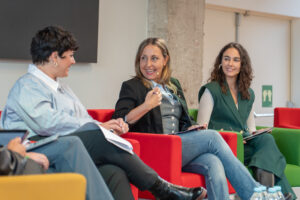
Marta Macias, the president of Forgender Seal, argued that feminist institutional leadership can only be sustained in the face of setbacks through collective empowerment and a sister network. “Personal empowerment is only the first step,’ she said. When women organise themselves and establish their own agenda, empowerment becomes structural. This is where feminist institutional leadership can really take root”. Contributions from the mayor of Santa Coloma, Mireia González, the mayor of Mollerussa, Marc Solsona, and the mayor of L’Hospitalet, Laura García, showed how equality can be institutionalised in both large cities and medium-sized municipalities.
Opening conference: Feminism, Human Rights and Local Politics
One of the highlights of the Forum was Núria Varela’s inaugural conference. Varela is a journalist, writer and international leader in public equality policies. Entitled ‘Feminism and local politics: an alliance to transform society’, Varela emphasised the importance of the international framework of human rights as a foundation for equality policies, highlighting instruments such as CEDAW, and the need to protect gender mainstreaming in public action. She warned of the growing prevalence of gender-based violence and the urgent need to combat it across all levels, including locally, where she emphasised the pivotal role of municipal administrations in safeguarding rights.
She emphasised the importance of evaluations as a means of improving, sustaining and legitimising feminist policies, and denounced the institutional and symbolic violence experienced by female politicians. She encouraged the establishment of support networks and active sisterhood among public representatives.

Feminist cities and narratives against hate speech
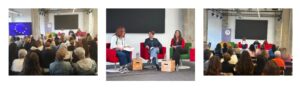
Tona Gusi moderated the panel on feminist leadership and narratives, placing the debate on resistance to reactionary discourses at its heart.
Anna Mercadé, a key figure in Catalan feminism, emphasised the importance of achieving women’s economic autonomy as a prerequisite for dismantling the foundations of patriarchy: “Without economic independence, there can be no real freedom or equality. Resources and opportunities must be guaranteed for all women if we want to curb reactionary discourse and transform the system” Mercadé also advocated for courageous, horizontal and inclusive leadership, emphasising the importance of recognising the voices of older women, migrant women and marginalised women within feminist public policies.
Silvina Molina, an Argentine journalist and gender editor at Télam, warned of the digital violence and censorship suffered by feminist communicators in Latin America. She called for international alliances to be forged at a municipal level.
Time as a right, co-responsibility as a challenge
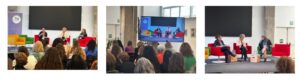
One of the most impactful tables was the one dedicated to co-responsibility in the use of time, led by Inma Moraleda and Marta Junqué. Moraleda shared the experience of the Santa Coloma Time Pact, outlining strategies to overcome internal resistance and establish time as a government priority. Junqué, from the Time Use Initiative, proposed public standards to ensure the right to time is realised: “If we don’t measure access to time, we perpetuate inequalities. We need real indicators and courageous public policies”.
Certification as a lever for evaluation and change
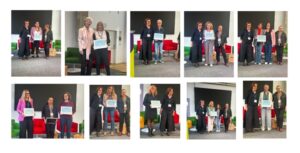
The Forum recognised the efforts of municipalities that have been awarded the SG CITY 50-50 Standard, which encourages evaluation, budget alignment, and ongoing improvement. Reus, Mollet, Cabrils, Algaida and other municipalities received the badge in recognition of their commitment to structural equality.
Message from the future
“Through collective empowerment, networking, and feminist local governance, we will be able to address the new social and democratic challenges facing our cities” Marta Macias concluded.
The Fifth Forum closed with a clear call to make equality an irreversible public policy, to protect progress, and to move together towards a feminist democracy on a global scale.